Fundraising – Premiums

Fundraising is a critical part of any non-profit’s functioning. Without it, all the dedication and inspiration in the world can come to naught if the funds to back your efforts are not there.

One tool in the fundraiser’s toolbox is premiums. They can be included in a donor or cold mailing, or a simple mailing can be designed around them.

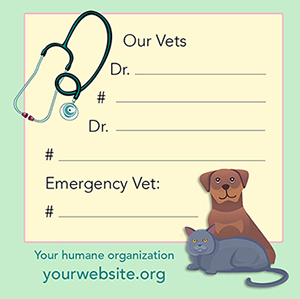
Pictured is a fridge magnet I created for a humane organization I worked for, included in both a donor and cold mailing. While pet parents likely have this information in their phones, others such as pet sitters, firefighters, and neighbors may not. In case of emergency, having this information easily accessible could save a pet’s life.

A magnet is just one possibility for a premium; other possibilities include bookmarks, seed packets, key chains, etc. What are your fundraising needs? As a graphic designer who has fund-raised in the non-profit field for 30+ years, I’d be happy to help you come up with premiums or entire programs to support your wonderful efforts.

Questions? Please contact me.

Traditional Publishing vs. Self-Publishing — Which Way to Go?

There are often two schools of thought on this, and there are two very different processes. In the end, there is the same product, a book that you have invested a great deal of time in writing, possibly illustrating, and a significant part of your heart. So how do you know which way to go?

In my talk, “Self-Publishing Children’s Books 101”, I introduce the numerous concepts and responsibilities involved in producing your own picture book. This gives you a solid starting point for further investigation.

I also discuss the advantages and disadvantages of going the traditional or self-publishing route. Here are a few questions you may want to ask yourself before embarking on your publishing journey.

  • Why are you writing your book? Do you want to reach a very broad audience or perhaps a smaller niche group of readers? Traditional publishers will reach the broadest audience, but also look for more mainstream subjects.
  • Is it important for your book to be in bookstores and libraries, as well as online? If yes, a traditional route may serve you better.
  • How much control would you like? If you have a strong vision of exactly how you want the illustrations, cover, and design, etc. to appear, self-publishing may be for you.
  • How much responsibility do you want to take for every aspect of the book’s journey – from writing, editing, design, illustration, marketing, and finding the people who will help you with these skills or learning them yourself? This speaks self-publishing; a traditional publisher will take care of all these for you.
  • How much financial investment do you wish to make? This is simply reality. If you self-publish, you will be paying for illustrators and designers to help you as well as the cost of printing the book. In today’s market, this will run several thousand dollars or more. There are no real out-of-pocket expenses involved in traditional publishing.
  • How patient are you? Querying agents and those publishers that are still open to submissions involves both research and generally, long waits to hear back. Want your book out there right away? Self-publishing is the way to go.

These are just some of the points you may want to consider. Hopefully, I’ve got you thinking about options for your upcoming children’s book. Do your homework, and read and research thoroughly!

If I can give a presentation on “Self-Publishing Children’s Books 101” at your library, school, or other venue, please contact me.

New Self-Publishing Workshop

Self-publishing one’s own children’s book has great appeal, but it’s not quite as simple as it seems. A most important question — what is your purpose in self-publishing?

If you wish to have a lovely book to read to the kids, grandkids, or your students, the journey may be fairly simple, and not terribly expensive. But if your goal is to compete with traditionally published books, and you truly want your book to sell, then your investment in both time and money may be more than you suspect.

I cover all this in my upcoming in-person workshop – Self-Publishing Children’s Books 101 – at the Stewartsville Public Library on Wednesday, October 18, 2023, 6-7:30 pm. Registration opens October 4.

I’ll be covering the following topics:

  • Why Publish?
  • Your idea – coming up with what will sell
  • Your story
  • Dummy
  • Illustration
  • Book design
  • Traditional vs. Self-Publishing
  • Q and A

If you’re in the neighborhood, please come and learn about self-publishing! For information about how I help people self-publish, please check out the tab on Self-Publishing above, or do a Search for the many articles I’ve written on this subject.

If I can help you self-publish, please contact me.

Be Remembered

We are often in a situation when you want to give the person you’re speaking with something to remember you by. Even in our digital age, print has a place.

Above you see three projects I recently completed for a client. Dr. Silverstein is expanding the promotion of her business and needed a new business card, but first she needed something else … a new logo. The new logo I created is now incorporated nicely into her new business card and other promotional avenues.

My client’s first book is being published this September. I was happy to research just the right images and design a bookmark that lets potential readers/purchasers know all about it.

A bookmark should always be tucked into your book at every possible opportunity, but also given out freely to anyone with whom you discuss your book. It easily becomes your best and simplest advertising promotion. You are, after all, talking to readers! Use a business card when you discuss the nature of your business for something that easily tucks into a pocket.

Good design is how they’ll remember you. If I can help you be remembered, please contact me.

Much More than Just Being Printed

To be realistic, self-publishing a children’s book is a lot of work. Depending upon what talents you bring to the table yourself, it also involves a lot of coordination of other people – an editor, if needed, an illustrator, and a graphic designer, at the least.

But getting the book finished and to press is only one part of the work. You still have to market your book! This is something you want to do for a traditionally published book as well, in addition to the publisher promoting you.

Some of the promotion needs to be ahead of the book’s release, and some after, but the bottom line is if you want your book to sell, be prepared to market it.

There’s plenty of in-depth information online about how to market, so here, I’m, going to offer you a few ideas that you might want to look into.

  • Reviews – if you want reviews, send your book in whatever format is required to reviewers in advance of the release. For some, like Kirkus, you will need to pay for a review. But you can also research bloggers who specialize in the genre, age-group and/or subject matter of your book and request online reviews.
  • Bookmarks – have these designed, printed, and ready to use in any of your promotions/mailings and to share with people you meet.You’ll also want to tuck a bookmark into each book you sell.
  • Press releases – these can be sent to local or national publications, aligned with your book’s subject matter, if appropriate. Be prepared to send PDFs by email or hard copies, whatever they require.
  • Events – look for events coming up where you and your book will be a good fit – book fairs, author events, or aligned fields of interest.
  • School visits – research and approach the schools in your area and further afield where you’re willing to travel to see if you might do school visits, and prepare to do presentations.
  • Book launch/book signings – ask your local bookstore or other similar venue if they would host you and a book signing.
  • Special mailings – reach out to organizations aligned with your subject matter and who might be willing to carry your book.

Keep in mind that, while self-published books have gained in both popularity and recognition, they are still not always accepted as the equivalent of a traditionally published book. Marketing is essential to sell books, so be prepared to learn and take the steps necessary to see your books in children’s hands!

Above, you see numerous ways I have been promoting my own picture book, Where Do Butterflies Go at Night?. I’ve sent a postcard mailing to butterfly gardens, a letter to local schools, am attending a crafts fair (again) with my book, making school visits, and very importantly, I designed my bookmarks which I give out every chance I get!

How can I help you? Please contact me, and let me know!

p.s. Where Do Butterflies Go at Night? is available at select book stores and everywhere books are sold online.

Promoting Your Children’s Book

There are many ways to promote a book, but some are a little more spectacular than others.

Pictured here is my debut picture book, “Where Do Butterflies Go at Night?” The artwork by illustrator Stella Maris-Mongodi is so rich, and truly magical.

I wanted to capitalize on that and get the book’s image, plus information about it, into the hands of those who would want to sell it – butterfly gardens and conservatories. And what better way than to send it to them?

I created a postcard for a mailing – a perfect 5 x 7″ size that won’t get lost in the incoming mail; have done some research; and have a list of these organizations to send to. The plus with this book is that it also has back matter addressing the importance of butterflies as pollinators. Something a butterfly conservatory may want to share with its patrons by way of education.

Digital promotion is very important, of course, but it’s much easier to ignore and delete an email than it is to toss away a gorgeous piece of art in your hands. A piece of art that may also bring an organization more money.

If I can help you promote your book, please let me know.

Self-Publishing VII – More on Illustration

Let’s take a moment to talk about the importance of illustration – good illustration – when self-publishing your book.

Here is an example of spectacular illustration, and I can proudly say that this – Where Do Butterflies Go at Night? – is my own debut picture book, and yes, it is traditionally published. But …

… this illustrator provides amazing art to both publishers and individuals alike. In fact, she, Stella Mongodi, has illustrated more picture books for self-publishing individuals than anything else.

One of the things I often see in self-published picture books is less-than-spectacular art. Why is that? Many first-time authors are excited about being published and appearing on Amazon, but when it comes to the art, they want to save money. I have come across this numerous times. The result? Not the best looking book!

The question is, do you want to sell your book? If you do, you will need to be prepared to pay a good illustrator and a good designer. You are competing with many, many other titles whose artwork is both eye-catching and professional. And those are the books that sell!

Next, you ideally want an illustrator who has some experience in picture books, or who can render illustrations to the size you require. If you’re doing an 8 x 8″ book, they should understand how a 2-page spread will lay out, how the art will fit in that format, and know what a bleed and a gutter is. As a children’s book designer, I spend a lot of time, which must be charged to the client, fixing and adjusting artwork that could have been done correctly initially. A good illustrator is so important, and It also helps greatly when you work with a good designer from the beginning.

The takeaway here? Do things in the proper order if you’re new to all this – a designer first to help with a dummy, book size, etc., and illustrator next. When the artwork is done, the designer will pull it all together for you. And be willing to invest what it takes to make your book shine and stand out in a crowd!!

Pictured here are the bookmarks I designed for my book. If interested, Butterflies is currently available for pre-order on bookshop.org, Amazon, and Barnes & Noble.

What Grabs Your Attention?

When you’re looking at a few publications, what draws you in? It may be the subject matter, but given the subject matter is the same, where do you look? I’ll tell you – you look at something that is well-designed. You are likely not even aware of it, but that’s what grabs your attention.

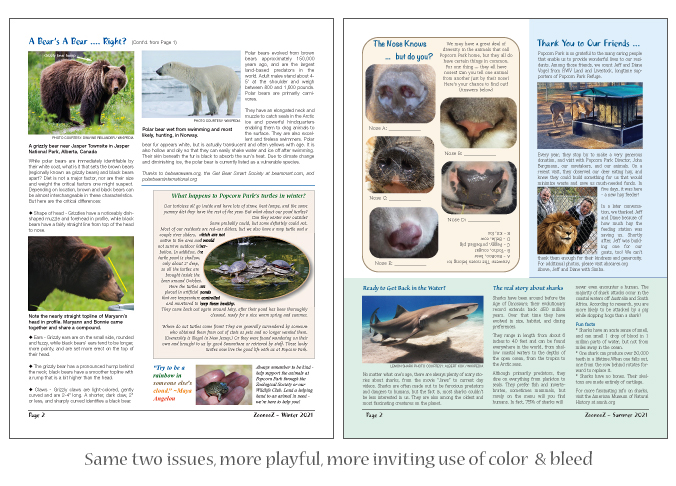
Here’s an example. This is ZoonooZ, the official newsletter of Popcorn Park Animal Refuge. I’ve been its editor and designer for many years, and while I’ve always been evolving its appearance over time, recently I’ve been been able to make some exciting updates. What’s the difference?

Expanded use of color combined with use of the bleed makes for a much more attractive look. There was a time when using a bleed (extending color or graphics right out to the very edge of the page), upped the printing costs considerably, but with most printers nowadays the cost is the same or the difference, nominal. Result? More design freedom and a look that draws you in.

Here’s what the newsletter looked like 10 years ago. Working with a non-profit can mean keeping a close eye on expenses. Even 10 years ago, 4/color printing cost sufficiently more than 2/color that we stayed within an economical look in black and brown. With the wider availability of digital printing, prices for the two became comparable, and we brought the ZoonooZ into full color.

Here’s page 2 of the same two issues. While I was already moving forward with more inviting use of color and design in the winter issue (left), by the time we got to summer? I was having way more fun. And which overall look are you most drawn to? I suspect it’s the issue on right.

I say fun, because design work should be fun. That’s my thought, anyway. And knowing that good design can draw people in, means they’ll look longer and get more involved with the subject matter, in this case a wildlife refuge. And what do we always hope? For a non-profit, we hope that this will translate into donation dollars for the charity. In the case of a business? More sales.

If I can help you/your organization bring you more attention with some wonderful design, feel free to let me know!

Getting to Know You

Beyond meeting you in person, how do people get to know you? Nowadays, the internet is going to be the primary way of learning about you, what you do, and what services and/or products you offer if you are in business. Between a website, blog, and social media, people will know plenty. And then, if they want to know more, they’ll pop your name into a search engine and know more than you’d probably ever think (or want) to tell them.
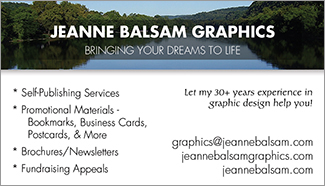
 

But let’s go back to that personal meeting and the humble business card. I recently re-designed my business card. The front, as you can see, echoes the exact same look as the header of this site. It includes my basic services, my website, this site/blog, and my e-mail.

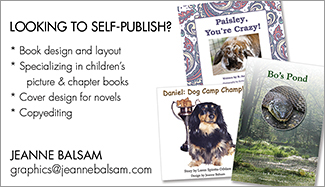
The back of the card provides information about an aspect of my business I am expanding, helping people self-publish in children’s books. I’ve detailed my services, provided a few samples, and repeated my e-mail.

Here’s what’s important about the front of the card looking like my web design – when people come visit, using my card for “directions”, they know they’re arrived at the right destination. Each time they look at my card or come to this site, I am now associated with that gorgeous river shot and that I will bring their dreams to life. (Yes, I will.) It’s called branding, or brand recognition. You recognize it best when you see a company’s logo which appears on all their products, communications, etc. However, I’m not that big of a company to need a logo (in my opinion), so I’ll be happy if you just connect the dots.
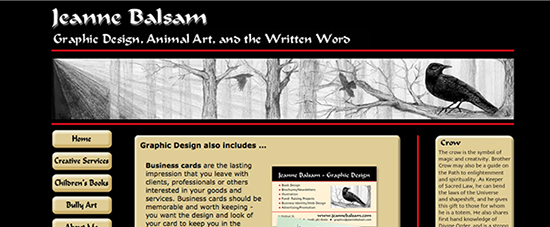
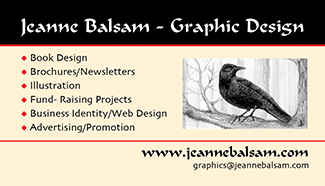
Let’s take a look at my last business card as it relates to my current website. Looking at a screenshot of my site, you can clearly see that the two are related and the same person. Both utilize my own artwork and a crow. (You’ll have to go to my website to read more on that.)

The card details what I do. It also listed my physical address and my phone number (deleted here), neither of which I choose to display nowadays, nor do I need to. Connected as we all are via the internet, my location is irrelevant, and I choose to make all initial contact via e-mail. I liked this card just fine, but I am also no longer offering some of those services;  the back side of the card needs to serve prospective clients better; and I want that all important visual cohesiveness.

So … getting to know you? I’m very happy to meet you, but when I go home, how will I remember who you are? I just met 30 people! Oh, I know – you gave me a business card. And look at that – I’ve arrived at your website and I can learn more.

How can I help you be better known? As you can see, I have a few ideas, so get in touch!


Business Cards

They’re light; they’re portable; and easy to save. Business cards really never go out of style, and anyone conducting business of any kind always needs to carry them with them.

The standard business card is 2″ x 3.25″, a little larger than what you see here in the post. To optimize the space on a business card, you generally want to take advantage and use both sides of the card and include as much information as you need to share.  But in some instances, one side will do. Those who take your cards can make notes on the blank side.

Because the space is limited, you want to think carefully about what wording will be on the card – certainly you need your name and/or business name, a visual that tells the story of you/your business, and contact information. In my own business card, upper left, you see only the front. The back features another illustration of mine and all my contact information.

In the card at right, there is no need for extended information beyond what the front of the card shows. What makes this card unique is that I did a portrait of one of Toni’s dogs and incorporated her favorite flower, the pansy, and then used that as the focus for her business card.

Another example of a one-sided card is the one I designed for Laurie Wallmark for her first published children’s book, Ada Byron Lovelace and the Thinking Machine. It’s simple, to the point, shows the beautiful book cover, and provides Laurie’s contact information.

Bring your business card with you everywhere, ready to hand  out to anyone who wants to know about you and what you do. Include them in mailings, with your product, in other businesses that will promote you, and so on. It’s one of the simplest and most basic ways you can promote yourself.

In addition to knowing what needs to be included on a business card, you also need to know a good designer, and that would be me. Contact me with your business card needs, and check here for additional samples of business cards I’ve designed.