Redesigning A Picture Book

The purpose of a redesign is to improve the quality of a project in visuals, text, or both.

My debut picture book, Where Do Butterflies Go at Night? was released, to my great excitement, in August 2022. Unfortunately, two years later, my small Australian publisher advised me they were going out of business. The result? My beautiful book would disappear off the face of the Earth.

Was there anything I could do?The only option was to purchase the art and rights, and self-publish the book myself. The original book was published hardcover, 8.5″ x 11″. In looking at my possibilities, POD (print-on-demand) offered only one size in common – 8.5″ x 8.5″ – between two different printers if I wanted the option of soft and hard covers.

This required a redesign in format, and some major changes in the artwork itself, but also offered an opportunity for additional creativity.

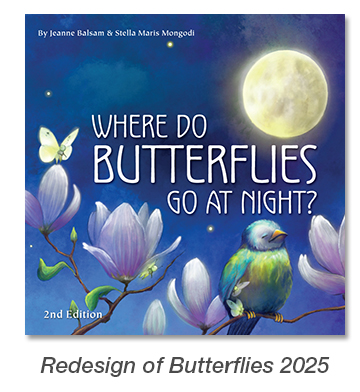
One of the important changes I made in a redesign was to make it more clear what the book is about by rebalancing the title text. In the initial cover, the book’s subject is unclear unless you come up close. I added 2nd Edition to my redesigned book, so it was known that this was not the same publisher, and also enlarged the names of the author (me) and illustrator (Stella Maris Mongodi).

I also set up the interior of the book to more closely resemble a traditional picture book. One of those additions was a half-title page. I also included a dedication page up front, and bios for Stella and me in the back, none of which were included in the original book, but which I felt deserved to be there.

The book also has back matter, providing information about butterflies, their importance as pollinators, and ways a child reader can help them, thereby making a difference in the world. I redesigned this spread to make it lighter and more readable.

One of the greatest challenges in redesigning “Butterflies” was recreating Stella’s beautiful art into a different size and format., as mentioned above. Here I am deeply grateful for my artistic talent which enabled me to make these changes, and to Stella, who was willing, with her approval along the way, for me to make the changes to her original art.

This sometimes required cropping from the outer edges of the spreads, but often cropping from the inner edges where the outside needed to remain intact, and digital repainting to make it all work. My goal here was to make the final book look like that’s exactly how Stella created it. One of our favorite spreads is below. Hopefully you can’t tell what may be missing from the original spread!

And so ends the tour of what a redesign looks like, the challenges and happy results. If interested in a redesign of one of your projects (need not be a book), please feel free to contact me.

If interested in purchasing Where Do Butterflies Go at Night, 2nd Edition you can find it here on Amazon.

Traditional Publishing vs. Self-Publishing — Which Way to Go?

There are often two schools of thought on this, and there are two very different processes. In the end, there is the same product, a book that you have invested a great deal of time in writing, possibly illustrating, and a significant part of your heart. So how do you know which way to go?

In my talk, “Self-Publishing Children’s Books 101”, I introduce the numerous concepts and responsibilities involved in producing your own picture book. This gives you a solid starting point for further investigation.

I also discuss the advantages and disadvantages of going the traditional or self-publishing route. Here are a few questions you may want to ask yourself before embarking on your publishing journey.

  • Why are you writing your book? Do you want to reach a very broad audience or perhaps a smaller niche group of readers? Traditional publishers will reach the broadest audience, but also look for more mainstream subjects.
  • Is it important for your book to be in bookstores and libraries, as well as online? If yes, a traditional route may serve you better.
  • How much control would you like? If you have a strong vision of exactly how you want the illustrations, cover, and design, etc. to appear, self-publishing may be for you.
  • How much responsibility do you want to take for every aspect of the book’s journey – from writing, editing, design, illustration, marketing, and finding the people who will help you with these skills or learning them yourself? This speaks self-publishing; a traditional publisher will take care of all these for you.
  • How much financial investment do you wish to make? This is simply reality. If you self-publish, you will be paying for illustrators and designers to help you as well as the cost of printing the book. In today’s market, this will run several thousand dollars or more. There are no real out-of-pocket expenses involved in traditional publishing.
  • How patient are you? Querying agents and those publishers that are still open to submissions involves both research and generally, long waits to hear back. Want your book out there right away? Self-publishing is the way to go.

These are just some of the points you may want to consider. Hopefully, I’ve got you thinking about options for your upcoming children’s book. Do your homework, and read and research thoroughly!

If I can give a presentation on “Self-Publishing Children’s Books 101” at your library, school, or other venue, please contact me.

What Exactly Is A Dummy?

Despite the name sounding potentially derogatory, a dummy is nothing more than a mock-up of the picture book you are working on. It’s a useful tool for several reasons:

  • helping you improve your manuscript
  • helping your illustrator have an idea of what she/he will need to do in terms of art and allowing space for text
  • and/or having something concrete to show agents or editors, especially if you wish to illustrate your own MS (manuscript)

A dummy will generally have the same amount of pages as a standard 32-page picture book, and can easily be made from paper, just like a miniature book. But … your dummy can also be created digitally, depending on your level of expertise and the ultimate goal of the dummy.

You will need to understand what appears on each page in a standard children’s book, such as title page, publisher’s information, etc., so you will know how and where to place your text and what illustrations might go on what pages. The beauty of a dummy is that you don’t need to know how to draw to create one; stick figures work!

This is a sample page from one of my own dummies. As an artist and graphic designer, it is more complex than yours may need to be, but contains the elements you want – a two page spread, an indication of what the illustration might look like, and where the type (text) will fall.

I suggest you take out a few current 32-page picture books from the library or use your own as reference, and create a first dummy for yourself. Paper, scissors, glue stick, and a pencil or two and your final manuscript, and go play. See what your picture book might look like! The exercise, at the very least, will show you where your story can be improved.

You can also check my online calendar to see when I am giving workshops near you. (Right now, I’m in western NJ and eastern PA,)

2024 – Ready to Self-Publish?

You have a story. Perhaps you have illustrated it. And you want to see your children’s book in print. You have submitted to publishers, but so far, have not gotten a `yes’. Time is slipping by and you’re not quite sure what to do.

Maybe it’s time to self-publish. Working with an experienced graphic designer who is also a published children’s book author and illustrator might be one of the best steps you can take to finally see your book in print.

I love helping authors bring their stories to children (and adults) who are waiting to hear what you have in your mind and heart. It’s a journey we share together with the best possible results – your story in a beautiful book.

Learn about how I help authors self-publish, and contact me when you’re ready to make your dream a reality.

Poem

New Self-Publishing Workshop

Self-publishing one’s own children’s book has great appeal, but it’s not quite as simple as it seems. A most important question — what is your purpose in self-publishing?

If you wish to have a lovely book to read to the kids, grandkids, or your students, the journey may be fairly simple, and not terribly expensive. But if your goal is to compete with traditionally published books, and you truly want your book to sell, then your investment in both time and money may be more than you suspect.

I cover all this in my upcoming in-person workshop – Self-Publishing Children’s Books 101 – at the Stewartsville Public Library on Wednesday, October 18, 2023, 6-7:30 pm. Registration opens October 4.

I’ll be covering the following topics:

  • Why Publish?
  • Your idea – coming up with what will sell
  • Your story
  • Dummy
  • Illustration
  • Book design
  • Traditional vs. Self-Publishing
  • Q and A

If you’re in the neighborhood, please come and learn about self-publishing! For information about how I help people self-publish, please check out the tab on Self-Publishing above, or do a Search for the many articles I’ve written on this subject.

If I can help you self-publish, please contact me.

Much More than Just Being Printed

To be realistic, self-publishing a children’s book is a lot of work. Depending upon what talents you bring to the table yourself, it also involves a lot of coordination of other people – an editor, if needed, an illustrator, and a graphic designer, at the least.

But getting the book finished and to press is only one part of the work. You still have to market your book! This is something you want to do for a traditionally published book as well, in addition to the publisher promoting you.

Some of the promotion needs to be ahead of the book’s release, and some after, but the bottom line is if you want your book to sell, be prepared to market it.

There’s plenty of in-depth information online about how to market, so here, I’m, going to offer you a few ideas that you might want to look into.

  • Reviews – if you want reviews, send your book in whatever format is required to reviewers in advance of the release. For some, like Kirkus, you will need to pay for a review. But you can also research bloggers who specialize in the genre, age-group and/or subject matter of your book and request online reviews.
  • Bookmarks – have these designed, printed, and ready to use in any of your promotions/mailings and to share with people you meet.You’ll also want to tuck a bookmark into each book you sell.
  • Press releases – these can be sent to local or national publications, aligned with your book’s subject matter, if appropriate. Be prepared to send PDFs by email or hard copies, whatever they require.
  • Events – look for events coming up where you and your book will be a good fit – book fairs, author events, or aligned fields of interest.
  • School visits – research and approach the schools in your area and further afield where you’re willing to travel to see if you might do school visits, and prepare to do presentations.
  • Book launch/book signings – ask your local bookstore or other similar venue if they would host you and a book signing.
  • Special mailings – reach out to organizations aligned with your subject matter and who might be willing to carry your book.

Keep in mind that, while self-published books have gained in both popularity and recognition, they are still not always accepted as the equivalent of a traditionally published book. Marketing is essential to sell books, so be prepared to learn and take the steps necessary to see your books in children’s hands!

Above, you see numerous ways I have been promoting my own picture book, Where Do Butterflies Go at Night?. I’ve sent a postcard mailing to butterfly gardens, a letter to local schools, am attending a crafts fair (again) with my book, making school visits, and very importantly, I designed my bookmarks which I give out every chance I get!

How can I help you? Please contact me, and let me know!

p.s. Where Do Butterflies Go at Night? is available at select book stores and everywhere books are sold online.

Self-Publishing Children’s Books 101

Wondering if self-publishing is for you? Want to know what is actually entailed in bringing a children’s book from idea to press?

Come to my workshop and find out. I’ll be providing as much information as can be fit into one hour, so you will have a better idea if this is the best route for you. We’ll also talk about the pros and cons of traditional publishing vs. self-publishing.

I am a graphic designer who has shepherded quite a few children’s books to press, but also a published author and illustrator, which brings an extra layer of knowledge to how I can inform and help you.

The workshop is free to the general public, but the library requests that you do register. Please sign up here.

Thanks and hope to see you!

Is 2023 Your Year to Be Published?

Are those your hands typing away on your manuscript? Are you done yet? If you’re considering self-publishing, this is the time to get in touch with a graphic designer!

Look into what’s involved before you have art done. Find out how making a dummy can make all the difference in your finished picture book, and save you money!

I specialize in helping children’s book authors bring your story and ideas together, design a beautiful book for you, and get it ready for press.

Are you ready? Start learning what’s involved right here on my website, and contact me with questions and let’s make a beautiful book for you!!

Promoting Your Children’s Book

There are many ways to promote a book, but some are a little more spectacular than others.

Pictured here is my debut picture book, “Where Do Butterflies Go at Night?” The artwork by illustrator Stella Maris-Mongodi is so rich, and truly magical.

I wanted to capitalize on that and get the book’s image, plus information about it, into the hands of those who would want to sell it – butterfly gardens and conservatories. And what better way than to send it to them?

I created a postcard for a mailing – a perfect 5 x 7″ size that won’t get lost in the incoming mail; have done some research; and have a list of these organizations to send to. The plus with this book is that it also has back matter addressing the importance of butterflies as pollinators. Something a butterfly conservatory may want to share with its patrons by way of education.

Digital promotion is very important, of course, but it’s much easier to ignore and delete an email than it is to toss away a gorgeous piece of art in your hands. A piece of art that may also bring an organization more money.

If I can help you promote your book, please let me know.

Workshop

Can I do a workshop for you?

As a published author and illustrator, graphic designer, and experienced public speaker, I am available to do a presentation on Self-Publishing 101 for Children’s Books.

I would be more than happy to educate your group on all that is entailed in self-publishing a children’s book. Workshop contents include critical points such as:
* Idea/concept
* Story
* Importance of a dummy
* Design
* Illustration
* Traditional Publishing vs. Self-Publishing

Interested? For complete details please contact me and inquire. I’d love to hear from you!

Please note that workshops need to be in reasonable travel distance from my home. Thank you!