Traditional Publishing vs. Self-Publishing — Which Way to Go?

There are often two schools of thought on this, and there are two very different processes. In the end, there is the same product, a book that you have invested a great deal of time in writing, possibly illustrating, and a significant part of your heart. So how do you know which way to go?

In my talk, “Self-Publishing Children’s Books 101”, I introduce the numerous concepts and responsibilities involved in producing your own picture book. This gives you a solid starting point for further investigation.

I also discuss the advantages and disadvantages of going the traditional or self-publishing route. Here are a few questions you may want to ask yourself before embarking on your publishing journey.

  • Why are you writing your book? Do you want to reach a very broad audience or perhaps a smaller niche group of readers? Traditional publishers will reach the broadest audience, but also look for more mainstream subjects.
  • Is it important for your book to be in bookstores and libraries, as well as online? If yes, a traditional route may serve you better.
  • How much control would you like? If you have a strong vision of exactly how you want the illustrations, cover, and design, etc. to appear, self-publishing may be for you.
  • How much responsibility do you want to take for every aspect of the book’s journey – from writing, editing, design, illustration, marketing, and finding the people who will help you with these skills or learning them yourself? This speaks self-publishing; a traditional publisher will take care of all these for you.
  • How much financial investment do you wish to make? This is simply reality. If you self-publish, you will be paying for illustrators and designers to help you as well as the cost of printing the book. In today’s market, this will run several thousand dollars or more. There are no real out-of-pocket expenses involved in traditional publishing.
  • How patient are you? Querying agents and those publishers that are still open to submissions involves both research and generally, long waits to hear back. Want your book out there right away? Self-publishing is the way to go.

These are just some of the points you may want to consider. Hopefully, I’ve got you thinking about options for your upcoming children’s book. Do your homework, and read and research thoroughly!

If I can give a presentation on “Self-Publishing Children’s Books 101” at your library, school, or other venue, please contact me.
What Exactly Is A Dummy?

Despite the name sounding potentially derogatory, a dummy is nothing more than a mock-up of the picture book you are working on. It’s a useful tool for several reasons:

  • helping you improve your manuscript
  • helping your illustrator have an idea of what she/he will need to do in terms of art and allowing space for text
  • and/or having something concrete to show agents or editors, especially if you wish to illustrate your own MS (manuscript)

A dummy will generally have the same amount of pages as a standard 32-page picture book, and can easily be made from paper, just like a miniature book. But … your dummy can also be created digitally, depending on your level of expertise and the ultimate goal of the dummy.

You will need to understand what appears on each page in a standard children’s book, such as title page, publisher’s information, etc., so you will know how and where to place your text and what illustrations might go on what pages. The beauty of a dummy is that you don’t need to know how to draw to create one; stick figures work!

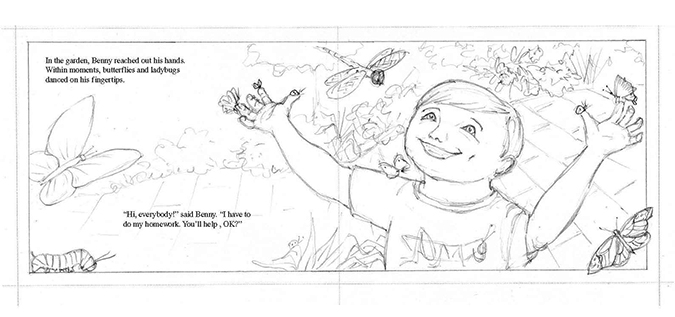
This is a sample page from one of my own dummies. As an artist and graphic designer, it is more complex than yours may need to be, but contains the elements you want – a two page spread, an indication of what the illustration might look like, and where the type (text) will fall.

I suggest you take out a few current 32-page picture books from the library or use your own as reference, and create a first dummy for yourself. Paper, scissors, glue stick, and a pencil or two and your final manuscript, and go play. See what your picture book might look like! The exercise, at the very least, will show you where your story can be improved.

You can also check my online calendar to see when I am giving workshops near you. (Right now, I’m in western NJ and eastern PA,)

New Self-Publishing Workshop

Self-publishing one’s own children’s book has great appeal, but it’s not quite as simple as it seems. A most important question — what is your purpose in self-publishing?

If you wish to have a lovely book to read to the kids, grandkids, or your students, the journey may be fairly simple, and not terribly expensive. But if your goal is to compete with traditionally published books, and you truly want your book to sell, then your investment in both time and money may be more than you suspect.

I cover all this in my upcoming in-person workshop – Self-Publishing Children’s Books 101 – at the Stewartsville Public Library on Wednesday, October 18, 2023, 6-7:30 pm. Registration opens October 4.

I’ll be covering the following topics:

  • Why Publish?
  • Your idea – coming up with what will sell
  • Your story
  • Dummy
  • Illustration
  • Book design
  • Traditional vs. Self-Publishing
  • Q and A

If you’re in the neighborhood, please come and learn about self-publishing! For information about how I help people self-publish, please check out the tab on Self-Publishing above, or do a Search for the many articles I’ve written on this subject.

If I can help you self-publish, please contact me.

Workshop

Can I do a workshop for you?

As a published author and illustrator, graphic designer, and experienced public speaker, I am available to do a presentation on Self-Publishing 101 for Children’s Books.

I would be more than happy to educate your group on all that is entailed in self-publishing a children’s book. Workshop contents include critical points such as:
* Idea/concept
* Story
* Importance of a dummy
* Design
* Illustration
* Traditional Publishing vs. Self-Publishing

Interested? For complete details please contact me and inquire. I’d love to hear from you!

Please note that workshops need to be in reasonable travel distance from my home. Thank you!

Growing in Our Fields of Interest

One of the things that’s important in any field we care about is growth. Are you growing in what you do, in what you care about, in where you want to go?

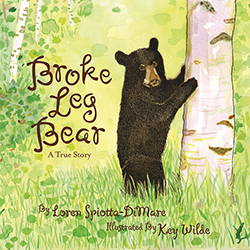
Based on the true story of the author’s Frenchie who defied the odds in agility

To this end, I think learning more and being involved is important in our being the best we can be, no matter what our interest, professional or otherwise. I am a regular attendee at SCBWI events (more on this sometime soon), but recently had the pleasure of being a guest speaker on a panel for an Animal Writers Workshop. Obviously, the commonality shared by both speakers and participants was our love of animals and writing. My fellow speakers shared their experiences in their writing process, road to publication, inspiration, and the difference in writing for a non-fiction vs. fiction reading audience and more. I spoke on the importance of good graphic design in self-publishing.

Flyer/program cover for the workshop, my design

With so many aspiring writers and illustrators turning to self-publishing nowadays – in addition to or instead of traditional publishing – there are new challenges to be faced. One of them is the importance of a well-designed product, which is where I, as a graphic artist, come in. My talk focused on some of the elements of good graphic design and how they come together to create an appealing book, and especially an appealing cover. I stressed how hiring a good graphic designer is every bit as important as a good illustrator, editor, and printer in publishing.

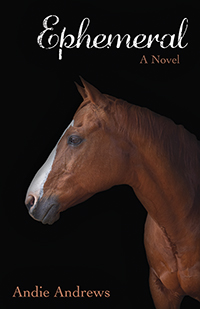
An adult novel from the point of view of the horse that changed the author’s life.

In a highly competitive field, now expanded due to self-publishing, you have literally seconds to grab the attention of a potential purchaser. A good portion of my talk included show-and-tell using examples to make my points. I brought along a bunch of particularly attractive children’s books from my own collection, had my fellow panelists hold up their well-designed books, and also showed a couple from my local library where I had tasked our librarian to find me some samples of poorly designed covers. I knew we had the right examples when I held up one of them and there were audible gasps from the audience!

It was a fun talk to an interested and interesting audience, with more opportunity for discussion afterwards at tables in an Authors Alley. Panelists and additional writers were  set up for book signings and a get-to-know with attendees.  What made this event so much fun was the sharing of experiences with fellow writers whose passion was our love of animals. Certainly, I had plenty to share, but I also found plenty to learn. And that’s what makes workshops and conferences both fun and important in our lives.

One of the books published by the event coordinator and moderator

If you have a dream, a passion, I encourage you to find opportunities to expand your knowledge and connect with others who share that passion. You will grow in many ways, some unexpected, and be inspired. Of course, if I can help you bring your dreams into fabulous visual format, just contact me and I’ll be happy to help.